
.png)
Accessibility is evolving from a "checkbox" to a premium standard. In our latest analysis for National ASL Day, we explore how industry giants like HBO Max and Amazon Prime Video are revolutionizing VOD through high-quality ASL and BASL (Black American Sign Language) interpretations. From the historic, record-breaking release of Sinners to the ongoing pop-culture influence of Barbie, we dive into the viewership data that proves inclusivity is driving deeper audience engagement. Discover why 2026 is the year sign language versions became a must-have for global blockbusters.
Even though accessibility tools in audiovisual content have existed since the analogue and digital television era, they have bloomed during the streaming era. Thanks to the flexibility in distributing content and new technological opportunities, platforms are now able to provide all necessary features for users with disabilities. The majority of movies and TV series have English closed captions providing not only a transcription of dialogues, but also additional information about other sounds. Amazon, with the usage of their artificial intelligence tools, has implemented a Dialogue Boost audio track to help their viewers better understand conversations in shows. Users with vision loss must rely on the audio description feature; additional narration on actions happening on the screen.
Adding sign language to recorded content is the most resource-intensive accessibility solution. In almost all cases, when platforms or other content distributors decide to add a sign-language enhanced versions of their content, they do it for American Sign Language (ASL). It is not the biggest sign language by the number of native signers, but it is used mainly in the most important markets for the streaming industry - the United States and the English-speaking part of Canada. Sign language has to be hardcoded into the content, so it is released in the form of separate material, other than the main programme.
In these circumstances questions might arise, why platforms should invest in adding sign language content to their offer, especially since they already allow users to watch already existing content with closed captions. Sign language is completely different from written language and it’s a native language for the vast majority of the deaf population. Using sign language interpreters is the only way to convey the tone of the actors and their emotions.
This case study will focus on the content adapted to the needs of sign language users and the popularity of the movies/TV series where sign language was one of the main themes. Our first analysis shows metrics for ASL versions of popular movies and shows. The first such release was ‘Barbie’ from 2023. Warner Bros. Discovery was eager to provide this version of their biggest blockbuster that year, which aligned with the inclusive values conveyed by the movie. The ASL version was also another nod into Barbie's heritage, the Barbie sign language teacher doll from the nineties. ‘Barbie with ASL’ was highly praised thanks to the work of the ASL performer, Leila Hanaumi, who co-operated with movie actors in her preparations.
Barbie’s success has resulted in creating other ASL interpretations, sometimes to the already released shows, sometimes simultaneously with new movie/episode releases.
Below you can find what percentage of unique viewers chose the ASL version in comparison to all viewers on the American market:
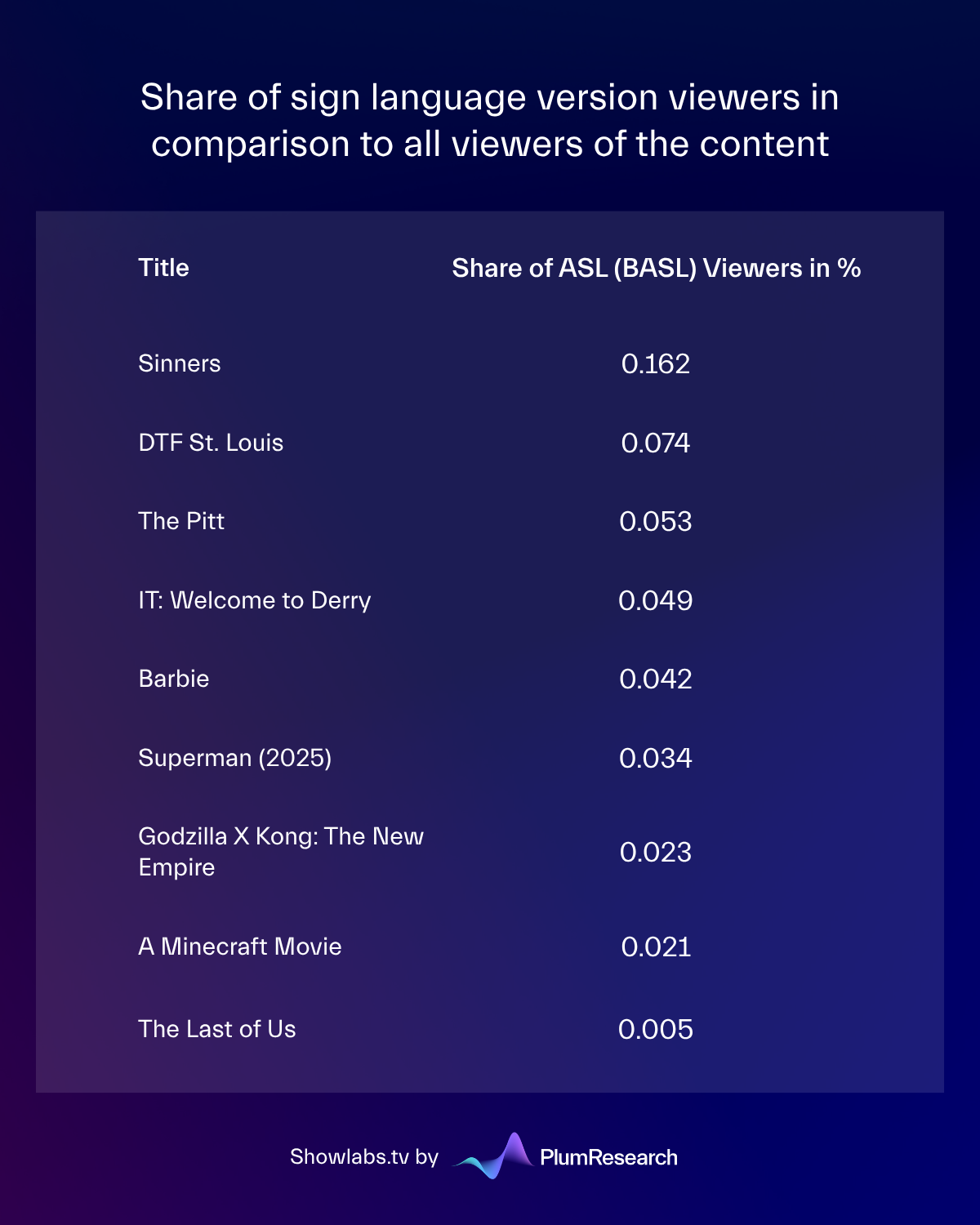
These figures might look miniscule at first, but they fully rely on the share of native speakers of sign language in the American population. The popularity of ‘Sinners’ can be explained by the cultural significance of the movie and its heritage, which was also shown in the sign language interpretation. Movie distributors have decided to release it with BASL, i.e., Black American Sign Language, a special dialect of ASL. BASL is also the effect of segregation in various areas of life, including education, which is symbolic in the case of the movie with racism effects as a significant part of the plot. ‘Sinners’ was the first movie in history interpreted into BASL.
ASL interpretations of shows like ‘DTF St. Louis’, ‘The Pitt’, and ‘IT: Welcome to Derry’ were released simultaneously with other versions. They also included scenes with deaf characters, which were appreciated by the American Deaf community. Quality of interpretations was highly praised, and it seems that providing them would become a standard practice in case of the most popular shows on HBO Max. However, more than 93% of the analyzed viewers of ASL content watched only one title interpreted into ASL.
But the aforementioned shows are not the only ones somewhat attached to the sign language community. Many of these productions are highly acclaimed like ‘CODA’, Academy Awards winner in 2022, Marvel Cinematic Universe movie ‘Eternals’, franchise ‘A Quiet Place’ and its sequel or Netflix TV series ‘Deaf U’. We decided to check their popularity during the ASL National Day (April 15th) among American viewers a year and two years ago.
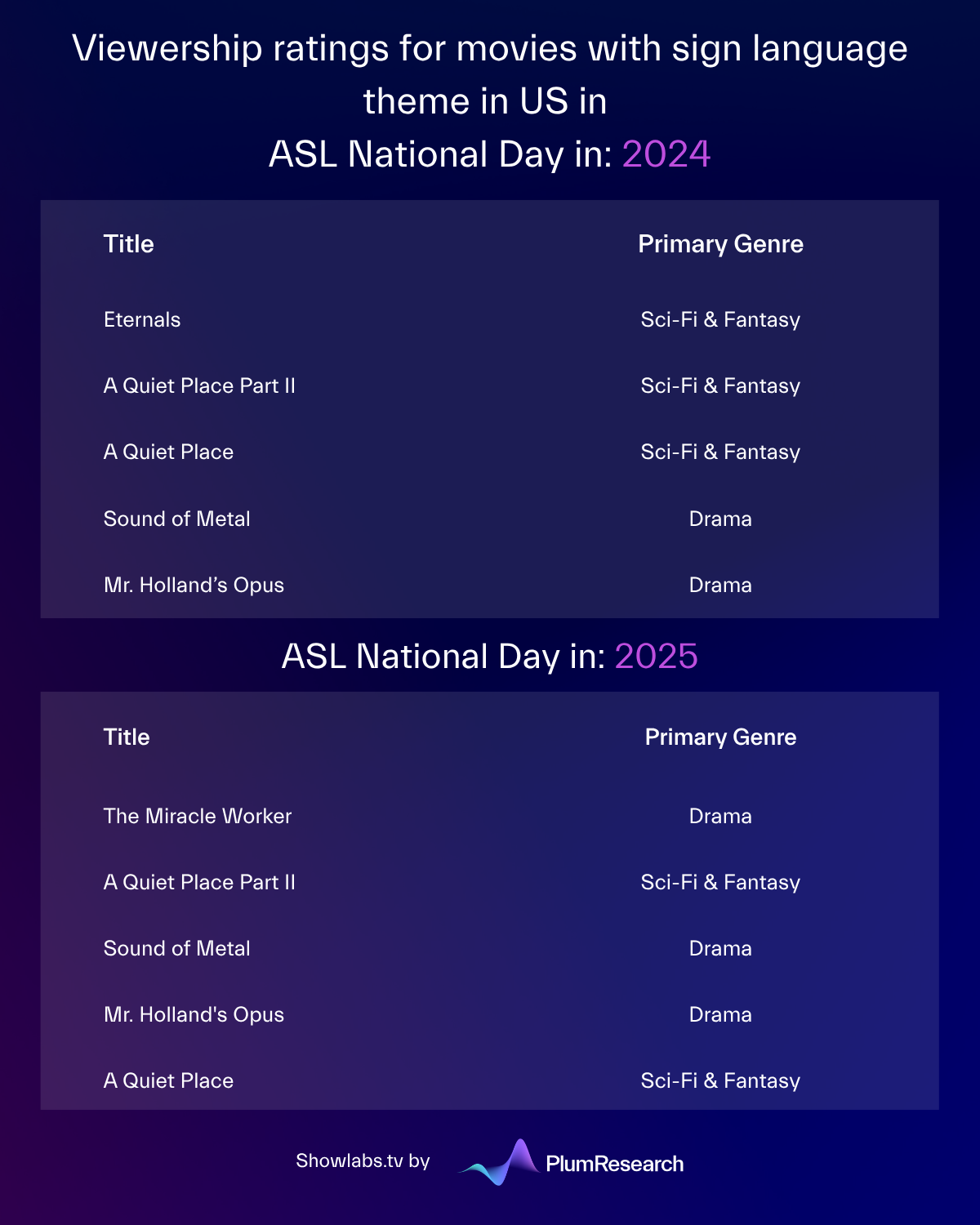
Newly created productions are on the top of the viewership ratings, but some classics about the life of deaf people and sign languages are still popular like ‘Mr Holland’s Opus’ from 1962. It shows that there is a demand for productions with ASL interpretations and deaf representation in media. Amazon Prime Video at the beginning of April announced the addition of American Sign Language and British Sign Language interpretation to 18 titles. More platforms, motivated by the HBO Max success, invest in similar endeavours. It seems that 2026 will bring the breakthrough in accessibility of sign language content.